

Integrated NMR and LC–MS approach uncovers subtle structural variations relevant to biologic drug quality
Scientists in Japan have developed a new analytical method capable of detecting subtle stereochemical differences that arise when therapeutic antibodies undergo oxidation. These differences, which were previously difficult to observe, can influence the stability and performance of antibody medicines.
By integrating advanced nuclear magnetic resonance (NMR) spectroscopy with liquid chromatography–mass spectrometry (LC–MS) and stereoselective enzymatic reactions, the researchers achieved atomic-level characterization of oxidative modifications in antibodies. The approach provides a new tool for improving the stability assessment and quality control of biologic drugs.
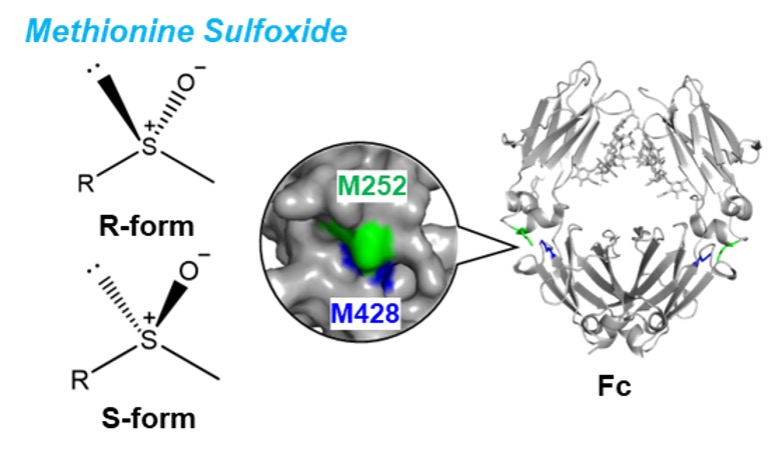
Structural environments of the methionine residues M252 (green) and M428 (blue) in the Fc region are shown. Upon oxidation, these residues are converted to methionine sulfoxide, generating two stereoisomeric forms with different spatial configurations (the S and R isomers).
Monoclonal antibodies are among the most widely used biologic medicines, with applications ranging from cancer treatment to autoimmune disease therapy. However, during manufacturing, storage, or transport, antibodies can undergo chemical changes that affect their stability and function. One common modification is oxidation of the amino acid methionine.
When methionine is oxidized, it forms methionine sulfoxide. This reaction produces two stereochemical variants—known as the S and R forms—which are chemically similar but differ in their three-dimensional arrangement. Conventional analytical techniques can detect oxidation, but distinguishing between these stereochemical forms has been extremely challenging.
In a study published in Analytical Chemistry, researchers from the Exploratory Research Center on Life and Living Systems (ExCELLS) of the National Institutes of Natural Sciences and collaborating institutions developed an integrated analytical strategy that resolves these subtle differences in the Fc region of IgG1 antibodies.
Using methyl-based NMR spectroscopy, the team detected distinct spectral signatures corresponding to different oxidized states of two conserved methionine residues in the Fc region, Met252 and Met428 (Figure). These residues play important roles in antibody stability and interactions with immune receptors.
To determine the stereochemical identity of the oxidation products, the researchers employed methionine sulfoxide reductase A (MsrA), an enzyme that selectively reduces the S-form of methionine sulfoxide. By comparing NMR spectra before and after enzymatic treatment, the researchers could clearly distinguish between the R and S forms of oxidation.
Complementary LC–MS analysis independently confirmed the chemical identities and relative abundances of the oxidized species.
Quote
“Oxidation of methionine residues is a well-known issue in antibody therapeutics, but the stereochemical diversity of these modifications has been difficult to analyze,” said Koichi Kato, professor at the Exploratory Research Center on Life and Living Systems (ExCELLS), National Institutes of Natural Sciences. “Our integrated NMR and LC–MS strategy allows us to visualize these subtle structural differences at atomic resolution.”
Because oxidation in the Fc region can influence how antibodies interact with immune receptors and how long they persist in the body, understanding these subtle structural variations is important for evaluating drug quality.
The researchers suggest that their analytical framework could strengthen stability testing, quality assessment, and manufacturing control of antibody therapeutics—an increasingly important issue as biologic medicines continue to expand in clinical use.
Related Research
This study complements a related paper published simultaneously in the Journal of the American Chemical Society, which established a residue-specific NMR framework for structural evaluation of the IgG1 Fc region. Together, the two studies provide a comprehensive platform for analyzing structural changes and chemical modifications in therapeutic antibodies.
Paper information
Maho Yagi-Utsumi, Saeko Yanaka, Noritaka Hashii, Kohei Tomita, Takashi Misawa, Yosuke Demizu, Akiko Ishii-Watabe, and Koichi Kato
Journal Name: Analytical Chemistry
Journal Title: “Stereochemical and Structural Characterization of Methionine Oxidation in the IgG1 Fc Region by Integrated NMR and LC-MS Analysis”
DOI: 10.1021/acs.analchem.5c06092