

Key points
- A research team led by Drs. Hiroyuki Imachi and Masaru K. Nobu of the Japan Agency for Marine-Earth Science and Technology (JAMSTEC) has successfully isolated and grown, for the first time, two strains of archaea*1 belonging to Heimdallarchaeia*2, a group considered to be the closest known archaeal relatives of eukaryotes (Fig. 1). These cultures open new opportunities to experimentally investigate how eukaryotic cells arose.
- Despite their close evolutionary relationship with eukaryotes, the strains had simple interiors and lacked membrane-bound organelles such as a nucleus. Meanwhile, their cell surface structure was complex, including long membrane protrusions. These protrusions mediated attachment to microbial partners essential for growth. These findings suggest that external (rather than internal) complexity may have helped the archaeal ancestor of eukaryotes establish close partnerships before a nucleus and other internal compartments emerged.
- Although both strains were oxygen-independent (anaerobic) and sensitive to oxygen, one had several systems to protect itself from oxygen and could grow even when small amounts of oxygen were initially present, as long as oxygen-utilizing (aerobic) bacteria were also present. This suggests that oxygen-consuming partners may have protected the anaerobic archaeal ancestor of eukaryotes, helping bridge the transition towards the oxygen-dependent lifestyle characteristic of most modern eukaryotes.
Terminology
*1 Archaea
Archaea constitute one of the three major groups of life, alongside bacteria and eukaryotes. Archaea and bacteria are prokaryotes: they are generally single-celled microorganisms whose cells lack a membrane-bound nucleus enclosing their DNA and other membrane-bound organelles. Eukaryotes, including animals, plants and fungi, have cells with a nucleus and other membrane-bound organelles, giving them a more complex internal organization.
*2 Heimdallarchaeia
A group within the phylum Promethearchaeota (formerly known as Asgard archaea), which has attracted considerable attention for its role in understanding the origin of eukaryotes. Environmental genomic studies suggest that eukaryotes arose from within Heimdallarchaeia.
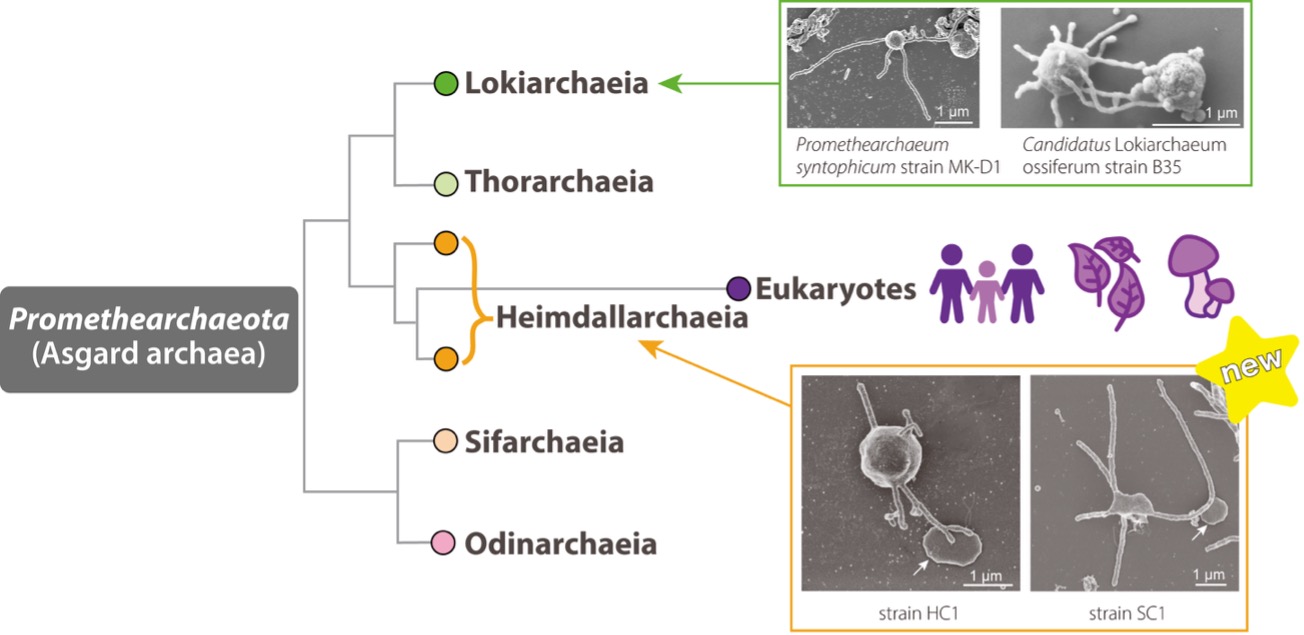
Figure 1. Evolutionary relationships between Promethearchaeota and eukaryotes, and electron micrographs of cultured strains.
The diagram on the left shows the evolutionary relationships between eukaryotes and groups within Promethearchaeota, an archaeal lineage of particular interest for understanding eukaryotic origins. Heimdallarchaeia, the group to which strains HC1 and SC1 isolated in this study belong, are the closest archaeal relatives of eukaryotes. The electron micrographs on the right show cultured archaea extending long protrusions from their cell surfaces. White arrows indicate their symbiotic partners, methane-producing archaea. The electron micrograph of strain B35 is reproduced from Rodrigues-Oliveira et al., Nature (2023), doi: 10.1038/s41586-022-05550-y.
Overview
The research team has for the first time isolated and cultivated two strains of Heimdallarchaeia, a group of archaea that are among the closest known archaeal relatives of eukaryotes – the organisms that include humans and other animals, as well as plants and fungi. By examining their cells and lifestyles directly, the team has gained the clearest picture yet of what the archaeal ancestor of eukaryotes may have looked like and how they lived.
How complex eukaryotic cells emerged remains one of the biggest mysteries in biology. A leading hypothesis is that they emerged when an archaeal cell belonging to Promethearchaeota formed a close partnership with a bacterium that eventually became the mitochondrion. In 2020, the JAMSTEC team first cultivated a member of this group, strain MK-D1, from deep-sea sediment. Based on its cell structure and metabolism, the team proposed the E3 model for the origin of eukaryotes (https://www.jamstec.go.jp/e/about/press_release/20200116/).
Studies of environmental DNA later suggested that Heimdallarchaeia, a lineage within Promethearchaeota, are the closest archaeal relatives of eukaryotes. Some researchers proposed that they might already have complex internal structures and/or the ability to use oxygen, like eukaryotes. However, because they had never been grown in the laboratory, their cell organization and physiology remained unverified. In this study, the team successfully cultivated two strains and examined them directly.
The researchers found that the internal structure of both strains was simple, lacking membrane-bound organelles such as a nucleus. Instead, the cell surface was complex, extending multiple long, branching membrane protrusions. These protrusions facilitated attachment to other microorganisms and formation of symbiotic partnerships. Although both strains were oxygen-independent (anaerobic) microorganisms, one had several systems to protect itself from oxygen and could grow even when small amounts of oxygen were initially present, as long as oxygen-utilizing (aerobic) bacteria were also present.
What separates eukaryotes from archaea is their complex internal structure and internal symbiosis with a former bacterium, yet how these two manifested remains enigmatic. First, the presented findings suggest that the archaeal ancestor of eukaryotes may have remained simple on the inside. Second, the team further discovered surface structure-mediated symbioses as the first biological connection between structural complexity and symbiosis in archaea. This supports the idea that the internal complexity of eukaryotic cells developed through surface structure-mediated symbiosis with the bacterial ancestor of mitochondria. Third, the results also suggest that this early partnership may have begun in an environment with low levels of oxygen and the partner may have helped the anaerobic archaea cope with oxygen. One of these archaea may have eventually taken the bacterial ancestor of mitochondria into its cell, leading to major changes in its cellular structure and metabolism and ultimately evolving into an ancient eukaryote.
The newly cultivated Heimdallarchaeia provide experimental models for studying the origin of eukaryotes. By investigating their cell structures and interactions with microbial partners, the researchers hope to better understand how a simple archaeal cell gave rise to the complex cells of eukaryotes.
This research was published in Nature on October 28, 2026 (London time) / October 29, 2026 (Japan time).
Paper Information
Journal Name: Nature
Journal Title: Eukaryotes’ closest relatives are internally simple syntrophic peptidotrophic archaea
Authors: Hiroyuki Imachi1*, Masaru K. Nobu1*, Shun’ichi Ishii1, Hiroki Hashiguchi2, Yuga Hirakata3, Naoki Hosogi2, Tetsuro Ikuta1, Yuta Isaji4, Makoto Miyata5, Masayuki Miyazaki1, Yuki Morono6, Kazuyoshi Murata7,8, Satoshi Nakagawa1,8,9, Akihiro Narita10, Miyuki Ogawara1, Satoshi Okada1, Yumi Saito1, Sanae Sakai1, Shigeru Shimamura1, Yuhei O. Tahara5, Yoshihiro Takaki1, Yoshinori Takano4, Eiji Tasumi1, Katsuyuki Uematsu11, Toshihiro Yoshimura4, and Ken Takai1,8
Affiliations:
- X-star, JAMSTEC
- JEOL Ltd.
- National Institute of Advanced Industrial Science and Technology (AIST)
- Biogeochemistry Research Center (BGC), JAMSTEC
- Osaka Metropolitan University
- Kochi Institute for Core Sample Research, JAMSTEC
- National Institute for Physiological Sciences (NIPS), National Institute of Natural Sciences (NINS)
- Exploratory Research Center on Life and Living Systems (ExCELLS), National Institute of Natural Sciences (NINS)
- Kyoto University
- Nagoya University
- MARINE WORKS JAPAN LTD.
* These authors contributed equally to this work.
DOI: 10.1038/s41586-026-11170-7
Contacts
For this study
Hiroyuki Imachi, Principal Researcher, Institute for Extra-cutting-edge Science and Technology Avant-garde Research of Life (X-star), JAMSTEC
Masaru K. Nobu, Senior Researcher, X-star, JAMSTEC
For press release
Press Office, Business Promotion Department, JAMSTEC
Public Relations & Brand Group, Corporate Communication Department, Management Strategy Planning Division, JEOL Ltd.
Media Relations Office, Branding and Public Relations Department, AIST
International Public Relations Office, OMU Global, Osaka Metropolitan University
Research Enhancement Strategy Office, ExCELLS, NINS
Research Enhancement Strategy Office, NIPS, NINS
Global Communications, KYOTO UNIVERSITY
Public Relations Division, General Affairs Department, Nagoya University, Tokai National Higher Education and Research System
Department of Administration, MARINE WORKS JAPAN LTD.