
This seminar is co-hosted by MEXT Promotion of Development of a Joint Usage/Research System Project: Coalition of Universities for Research Excellence Program (CURE) “Frontier of Spin Life sciences (Spin-L)”.
Language
English
Date
2026.5.18(Mon)16:00~17:00
Place
Building 3, West 2nd floor, Large Meeting Room, Yamate Campus
Exploratory Research Center on Life and Living Systems (ExCELLS)
National Institutes of Natural Sciences, Okazaki, Japan
Speaker
Prof. Göran Widmalm
Arrhenius Laboratory, Stockholm University
Title
GLYCAN STRUCTURE BY NMR
Abstract
NMR spectroscopy studies of glycans commonly utilize the spin-½ nuclei, 1H and 13C, and when present 15N and 31P, but other nuclei such as 19F and 77Se have also been employed in investigations of carbohydrates and their interactions with proteins. The limited spectral dispersion of oligo- and polysaccharides where most 1H chemical shifts are found in the spectral region ~3 – 4 ppm and most 13C chemical shifts are found in the spectral region ~60 – 80 ppm make resonance assignments a challenging process.1,2)
Concatenation of NMR modules into a single 2D NMR experiment improves efficiency and results in time saving due to the fact that two or more experiments share a common recovery delay prior to each subsequent scan of the 2D NMR experiment. This concept has been extended to parallel NOAH (NMR by Ordered Acquisition using 1H-detection) supersequences utilizing sequential, parallel and time-shared acquisitions by which ten spectra can acquired in a single measurement, referred to as a p-NOAH‑10.3) A p-NOAH‑5 measurement was also tailored to produce NMR data for the computer program CASPER.4,5)
Resonance overlap in NMR spectra of oligosaccharides can be greatly reduced, and resolution improved, by utilizing pure shift methods. Even though many correlations are resolved in 1H,13C-HSQC NMR spectra some may still remain, among other things, due to 1H,1H couplings, though these may be refocused and the resulting pure shift 1H,13C-HSQC NMR spectra are thus devoid of the homonuclear proton-proton couplings. However, peak-picking of cross-peaks in 2D NMR spectra is often time-consuming, limiting the potential of CASPER as an efficient analysis tool. Since pure shift methods aim to collapse multiplets into well-resolved singlets, pure shift data are ideal for use in conjunction with CASPER, allowing for efficient analysis by using automated peak-picking routines.6) Further refinement of 1H NMR chemical shifts and nJHH may be carried out by spin-simulation resulting in data useful for conformational analysis of the glycans.
1. C. Fontana, G. Widmalm, Chem. Rev. 2023, 123, 1040-1102.
2. G. Widmalm, JACS Au 2024, 4, 20-39.
3. Ē. Kupče, J.R.J. Yong, G. Widmalm, T.D.W. Claridge, JACS Au 2021, 1, 1892-1897.
4. M. Lundborg, G. Widmalm, Anal. Chem. 2011, 83, 1514-1517.
5. K. M. Dorst, G. Widmalm, Methods Mol. Biol. 2025, 2961, 23-38.
6. M. J. Smith, E. L. Gates, G. Widmalm, R. W. Adams, G. A. Morris, M. Nilsson, Org. Biomol. Chem. 2023, 21, 3984-3990.
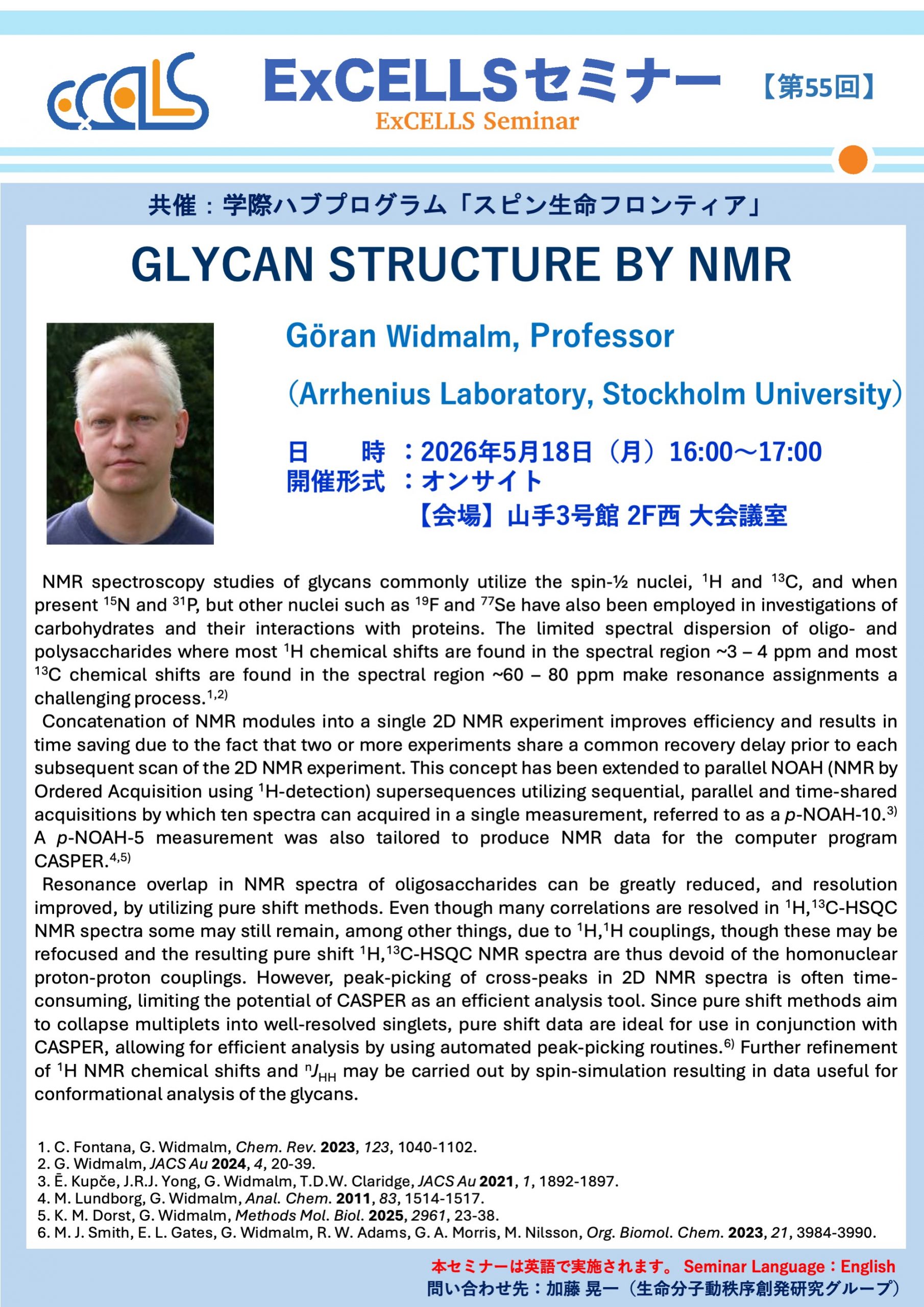
Poster
Contact
Biomolecular Organization Research Group
KATO, Koichi
Gallery