

How do photosynthetic organisms harvest light so efficiently? To help answer this question, researchers have developed an ultrafast transient absorption microscope with sensitivity approaching the single-molecule level.
Plants and photosynthetic bacteria have a wide variety of light-harvesting antennae in which pigment molecules are precisely arranged to utilize light energy efficiently. However, these molecular arrangements are not perfectly uniform and vary from particle to particle because of conformational distortions and fluctuations. Such structural variations are considered to perturb excited states and energy transfer processes triggered by light absorption. Because these early excitation dynamics initiate a cascade of photosynthetic photochemical reactions, understanding the effects of such fluctuations and heterogeneities is essential for revealing how phototrophic organisms maintain efficient and stable photosynthesis.
To analyze these fluctuations and heterogeneities, single-molecule fluorescence spectroscopy has been widely utilized. However, the fluorescence-based approach faces fundamental challenges in observing ultrafast and multistep processes, as well as non-fluorescent dark states and radical species. In contrast, transient absorption spectroscopy can track excitation dynamics, including excited-state relaxation and energy transfer, on the femtosecond timescale. Until now, however, improving its sensitivity to the single-molecule level has remained a major challenge. This technical breakthrough is expected to open the door to a deeper understanding of the regulatory mechanisms of photosynthetic photochemical systems in which fluctuations and heterogeneities are intrinsic.
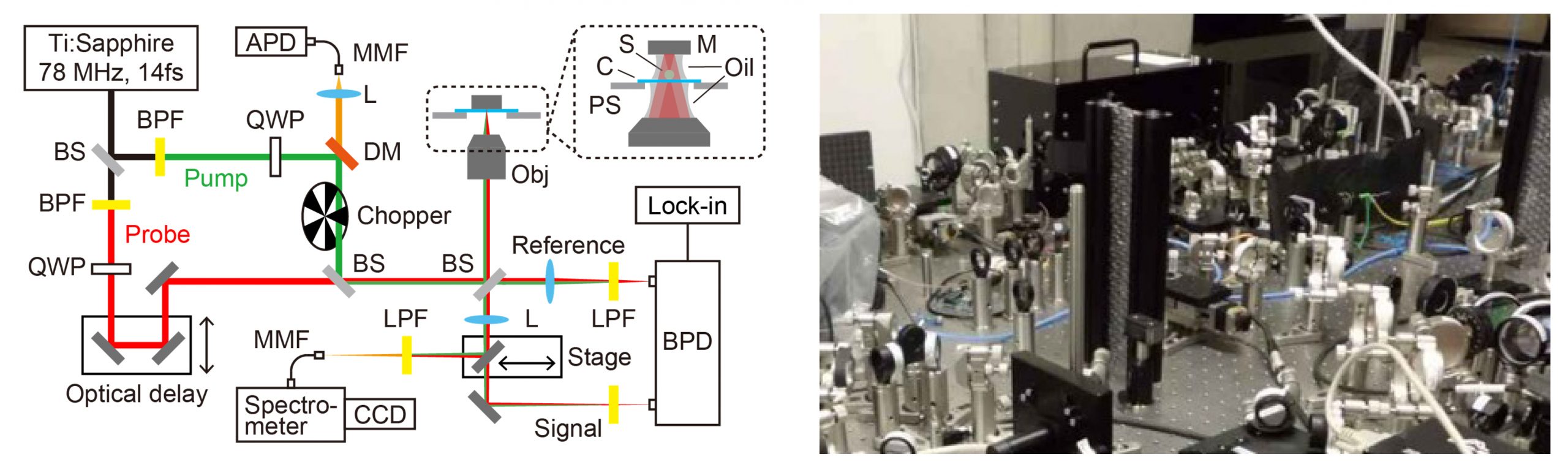
An article published in The Journal of Physical Chemistry Letters describes a new transient absorption microscope developed by a research group led by Prof. Toru Kondo at the National Institute for Basic Biology (NIBB) / the Exploratory Research Center on Life and Living Systems (ExCELLS) / SOKENDAI. This microscope integrates a unique optical alignment for single-objective absorption microscopy, a highly sensitive balanced detector, and lock-in-amplified detection, allowing femtosecond time-resolved transient absorption measurements to be performed continuously at a high repetition rate. Moreover, steady-state absorption and fluorescence measurements, i.e., simultaneous absorption and fluorescence imaging, can be performed. Furthermore, the fluorescence spectrum and lifetime can be acquired. The spatial resolution is ~300 nanometers, near the diffraction limit; the temporal resolution is less than 200 femtoseconds; and the detection sensitivity of the transient absorption signal is about 10–7 in absorbance, approaching the single-molecule level.
Using the newly developed microscope, the research group analyzed Zn-HM pigment self-aggregates that mimic the chlorosome, a photosynthetic light-harvesting antenna found in green sulfur bacteria. As a result, they identified two kinetic components with nearly identical time constants based on differences in their time-constant distributions that are averaged out in conventional ensemble measurements. Moreover, they succeeded in quantifying the photophysical properties associated with these components, such as absorbance, fluorescence efficiency, and fluorescence peak ratio, revealing how structural heterogeneity and disorder contribute to excitation dynamics and excitonic coherence domains.
Graduate student Shun Arai, the first author of the paper, says, “Structural fluctuations and heterogeneities inherently exist not only in photosynthetic systems, but also in living systems as a whole. We believe that our original microscope and analytical framework can deepen our understanding of living systems from the perspective of heterogeneous local dynamics”. Furthermore, Toru Kondo says, “A key advance of this work is the establishment of a new spectroscopic analysis method that exploits interparticle heterogeneity itself as meaningful information, rather than focusing only on average time constants. Although heterogeneity has often been treated merely as noise and averaged out, this study shows that actively resolving it can reveal the essential photophysical properties”.
The new ultrafast microspectroscopic approach established in this study can be widely applied to the analysis of light-harvesting antennae and reaction centers responsible for photoconversion processes in photosynthetic organisms. Moreover, its applicability is not limited to photosynthesis research but also extends to materials development research on organic photofunctional devices, artificial light-harvesting systems, and molecular electronics. It is expected to provide novel materials design principles by revealing the relationship between microscopic structures and photophysical properties at the single-molecule or single-particle level, a relationship that is difficult to elucidate using conventional ensemble-averaging techniques.
Paper information
Journal Name: The Journal of Physical Chemistry Letters
Journal Title:Heterogeneity-Resolved Ultrafast Transient Absorption Spectroscopy of Single Supramolecular Light-Harvesting Antennas
Authors: Shun Arai, Shogo Matsubara, Toru Kondo
Article Publication Date: April 2nd 2026
DOI: https://doi.org/10.1021/acs.jpclett.6c00164
Contacts
Expert Contact:
Prof. Toru Kondo
National Institute for Basic Biology (NIBB)
Exploratory Research Center on Life and Living Systems (ExCELLS)
SOKENDAI
E-mail: tkondo_at_nibb.ac.jp
(Please replace the “_at_” with @)
Press Release